|
Comparison: Hubble vs Webb Space Telescopes
The James Webb Space Telescope (JWST)
and Hubble Space Telescope are complementary observatories rather
than direct replacements, differing primarily in their wavelength
focus and locations. Hubble operates mainly in visible and
ultraviolet light, while Webb is optimized for infrared light,
allowing it to peer through cosmic dust and see the earliest, most
distant galaxies.
|
Core
Differences of Hubble Telescope vs Webb Telescope at a Glance |
| Feature |
Hubble
Space Telescope |
James
Webb Space Telescope |
| Primary
Mirror |
2.4 meters
(7.9 feet) |
6.5 meters
(21.3 feet) |
| Main
Wavelength |
Ultraviolet,
Visible, Near-Infrared |
Near-Infrared
to Mid-Infrared |
| Location |
Low-Earth
orbit (340 miles up) |
Sun-Earth L2
Lagrange point (1 million miles away) |
| Primary
Mission |
Galaxy
evolution, local universe, stellar lifecycles |
First
galaxies, exoplanet atmospheres, star formation |
|
Resolution/Sensitivity |
High
resolution in visible light |
~100x more
sensitive; pierces dense dust clouds |
|
Why Hubble is still vital:
- Ultraviolet Vision: Hubble can
detect ultraviolet light, which is crucial for studying the
atmospheres of planets and the hottest, youngest stars. Because
Earth's atmosphere blocks UV light, a space-based telescope is
required to see it.
- Visible Light: It sees in the
same wavelengths as the human eye, providing the iconic, crisp,
true-color images of the cosmos we are most familiar with.
Why James Webb is more advanced:
- Infrared Capabilities: Because
the universe is expanding, light from the most distant objects
gets stretched (redshifted) from visible light into the infrared
spectrum. Webb's infrared instruments are designed to detect
these ancient, faint light sources.
- Dust Penetration: Infrared
light can pass through thick clouds of cosmic gas and dust. This
enables Webb to look inside stellar nurseries and see infant
stars that are completely hidden from Hubble's view.
- Larger Light-Gathering Area:
Webb's gold-coated honeycomb mirror is much larger than
Hubble's, giving it roughly six times the light-collecting
power. This allows Webb to see objects up to 100 times fainter
than Hubble.
Location and Maintenance: Hubble
orbits just above Earth's atmosphere, allowing astronauts to
physically visit and service the telescope (which they have done
several times since its 1990 launch). Webb, on the other hand, is
positioned a million miles away at the second Lagrange point (L2).
This deep-space orbit keeps the telescope cool and shields it from
the heat and light radiating from Earth, which is essential for
its sensitive infrared instruments.
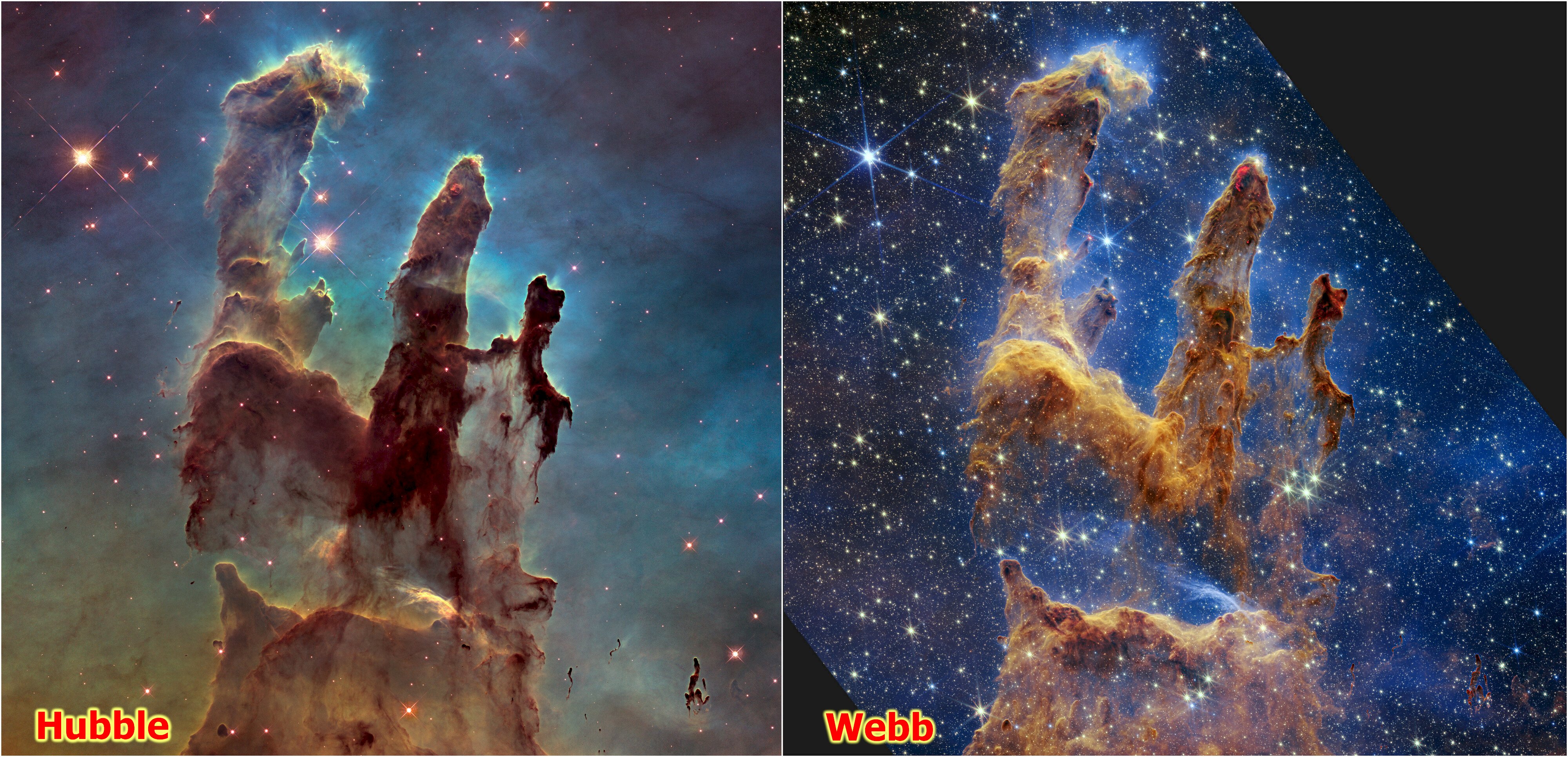
For a side-by-side visual comparison of images taken by both
Hubble and Webb, showing exactly how much deeper JWST can see:
See also
this comparative image and also
this comparative image
NASA Site =
https://science.nasa.gov/mission/hubble/observatory/hubble-vs-webb/
The
Hubble Space Telescope
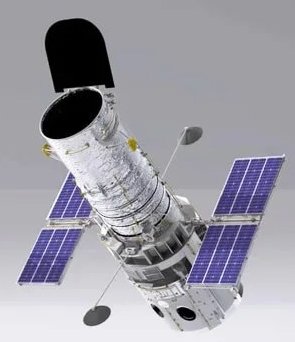 Launched
in 1990, the NASA/ESA Hubble Space Telescope orbits 332 miles
above Earth. By peering above the atmospheric distortion, this
bus-sized observatory delivers ultra-sharp optical, ultraviolet,
and near-infrared images that have revolutionized humanity's
understanding of the universe, including the discovery of dark
energy. Launched
in 1990, the NASA/ESA Hubble Space Telescope orbits 332 miles
above Earth. By peering above the atmospheric distortion, this
bus-sized observatory delivers ultra-sharp optical, ultraviolet,
and near-infrared images that have revolutionized humanity's
understanding of the universe, including the discovery of dark
energy.
Quick Facts
- Launch: April 24, 1990 (via
Space Shuttle Discovery)
- Orbit: Low-Earth orbit at ~569
km (~332 miles)
- Size: 13.2 meters (43 feet)
long with a 2.4-meter (94-inch) primary mirror
- Wavelengths: Ultraviolet,
visible, and near-infrared
Scientific Legacy
Hubble has performed over 1.7 million observations and has been
central to some of the most significant astronomical breakthroughs
of the modern era:
- Dark Energy: Discovered in 1998
that the expansion of the universe is accelerating.
- Exoplanet Atmospheres:
Pioneered the field of studying the atmospheric composition of
planets beyond our solar system.
- Deep Fields: Created
breathtaking "deep field" images—like the Hubble Ultra Deep
Field—revealing thousands of previously unseen, distant
galaxies.
- Age of the Universe: Helped
determine the expansion rate of the universe and pinpointed its
age to approximately 13.8 billion years.
How It Works
Unlike ground-based telescopes, which must peer through the
shifting, hazy layers of Earth’s atmosphere, Hubble has a direct
window to the cosmos. Starlight enters the telescope and hits the
primary mirror, which reflects the light onto specialized
instruments. These include cameras to capture its iconic imagery
and spectrographs used to analyze the chemical composition of
stars, planets, and galaxies.
Maintenance and Future
Unlike most space probes, Hubble was specifically designed to be
serviced by astronauts. Between 1993 and 2009, space shuttle crews
completed five complex repair and upgrade missions. Today, while
it is nearing the end of its operational lifecycle and grappling
with aging gyroscopes, it continues to operate in tandem with the
James Webb Space Telescope to map the cosmos.
NASA Site =
https://science.nasa.gov/mission/hubble/
The James Webb
Space Telescope
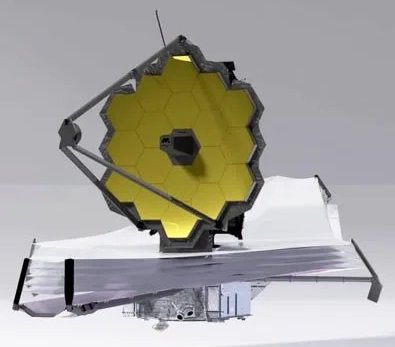 The
James Webb Space Telescope (JWST) is NASA's most powerful space
observatory. Designed to succeed the Hubble Space Telescope, its
primary mission is to look back 13.5 billion years to observe the
first galaxies born after the Big Bang and to study the
atmospheres of distant alien worlds. The
James Webb Space Telescope (JWST) is NASA's most powerful space
observatory. Designed to succeed the Hubble Space Telescope, its
primary mission is to look back 13.5 billion years to observe the
first galaxies born after the Big Bang and to study the
atmospheres of distant alien worlds.
How It Works
- Infrared Vision: Unlike Hubble,
which primarily sees visible light, Webb focuses on infrared
astronomy. Because the universe is expanding, light from the
earliest stars and galaxies stretches into the red and infrared
spectrum—a phenomenon called redshift.
- Gold-Plated Mirrors: Its iconic
21.3-foot primary mirror is composed of 18 hexagonal segments
made of beryllium and coated in a microscopically thin layer of
pure gold to optimize the reflection of infrared light.
- Tennis-Court Sunshield: Because
the telescope operates via heat-sensitive infrared detectors, it
utilizes a five-layer, tennis-court-sized sunshield that blocks
the heat and light of the Sun, Earth, and Moon.
Where It Lives
Webb does not orbit Earth. It is parked in a "halo orbit" around
the second Lagrange point (L2), which is located about 1 million
miles (1.5 million kilometers) away from Earth. This position
keeps the Earth and Sun in a straight line behind the telescope's
sunshield, allowing it to stay extremely cold and undisturbed.
Key Scientific Goals
- The Early Universe: It acts as
a time machine to study the "Cosmic Dawn," observing how the
very first galaxies and stars formed and evolved.
- Exoplanet Atmospheres: By
analyzing starlight passing through the atmospheres of planets
outside our solar system, Webb can detect chemical
fingerprints—such as water vapor, methane, and carbon
dioxide—assessing if an exoplanet might be habitable.
- Star Lifecycles: Webb's
infrared instruments can peer directly through thick, opaque
clouds of cosmic dust where baby stars and planetary systems are
actively being born.
NASA Site
=
https://science.nasa.gov/mission/webb/
|