|
My
Great-Great-Uncle "Bus" Harmon
A Past
Sheriff of Walker County, Georgia
 Weymon
F. "Bus" Harmon (9/14/1906 - 9/23/1971), a man known for always
wearing Old Spice, was the Sheriff of Walker County,
Georgia from 1949 to 1956 and
again from 1961 to 1964. His father, Lambert W. Harmon
(7/27/1878 - 5/14/1945), had also been the Sheriff of Walker
County from 1921 to 1928, and his grandfather, John W. Harmon
(2/19/1852 - 2/28/1937), had been Justice of the Peace before
him, so for at least 3 generations, the Harmon family was part
of the law enforcement in Walker County Georgia, and the
Harmon's were well-known to all. Weymon
F. "Bus" Harmon (9/14/1906 - 9/23/1971), a man known for always
wearing Old Spice, was the Sheriff of Walker County,
Georgia from 1949 to 1956 and
again from 1961 to 1964. His father, Lambert W. Harmon
(7/27/1878 - 5/14/1945), had also been the Sheriff of Walker
County from 1921 to 1928, and his grandfather, John W. Harmon
(2/19/1852 - 2/28/1937), had been Justice of the Peace before
him, so for at least 3 generations, the Harmon family was part
of the law enforcement in Walker County Georgia, and the
Harmon's were well-known to all.
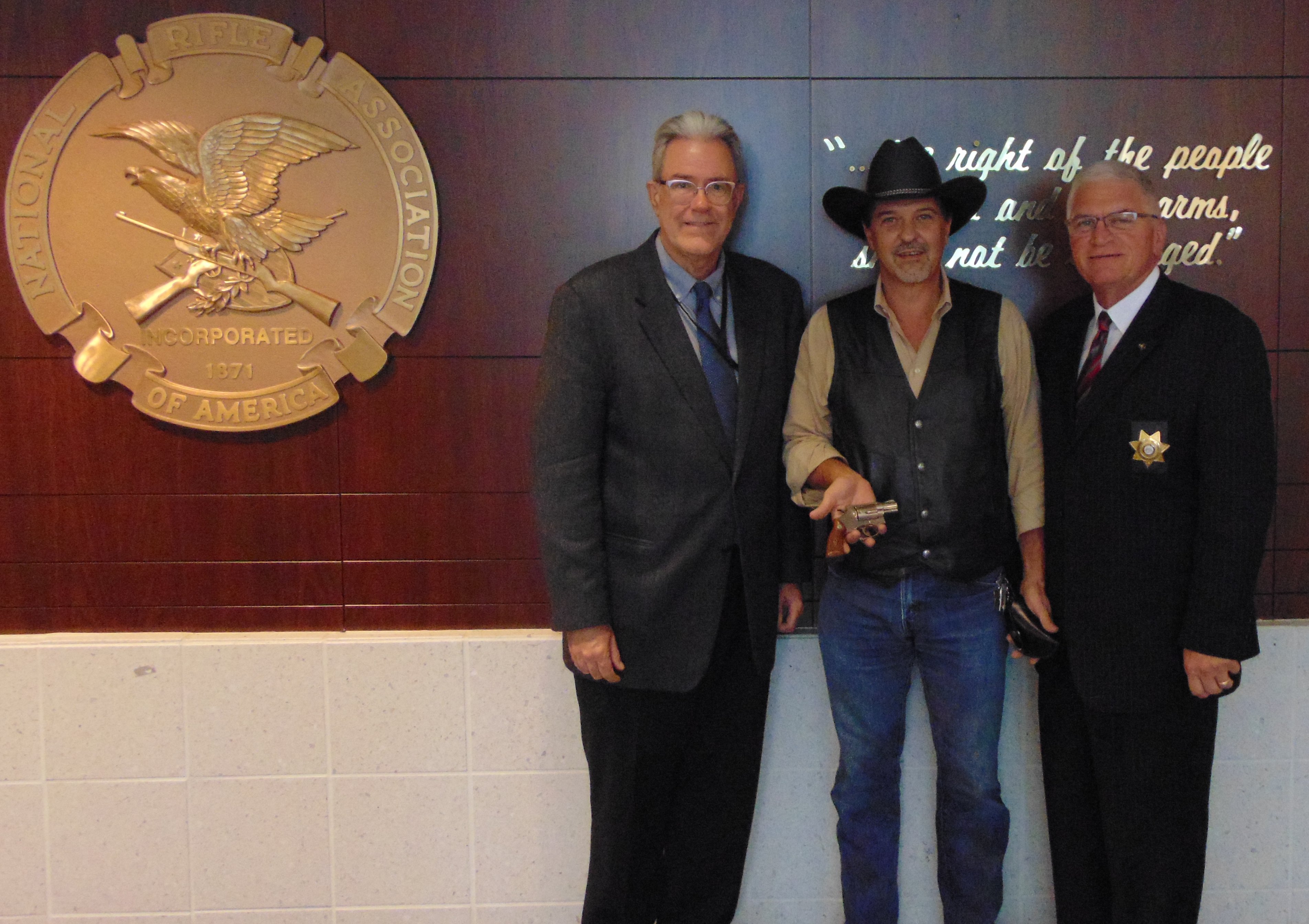
Uncle Bus's personal sidearm
was donated to the National Rifle Association's Firearms Museum
Director Jim Supica on October 11,2018 by James David Burney
along with a photo of Uncle "Bus". Additionally, the current
Sheriff of Walker County Georgia, Steve Wilson, attended and
donated a badge and signed murder warrant to accompany the
firearm.
Click here for photos of the donation and
tour.
CLICK HERE FOR UNCLE
BUS's REVOLVER (HIGH RESOLUTION PHOTOS)
In Holster |
Left Side |
Right Side |
Butt |
Frame Under
Chambers Arm |
Chambers
 As
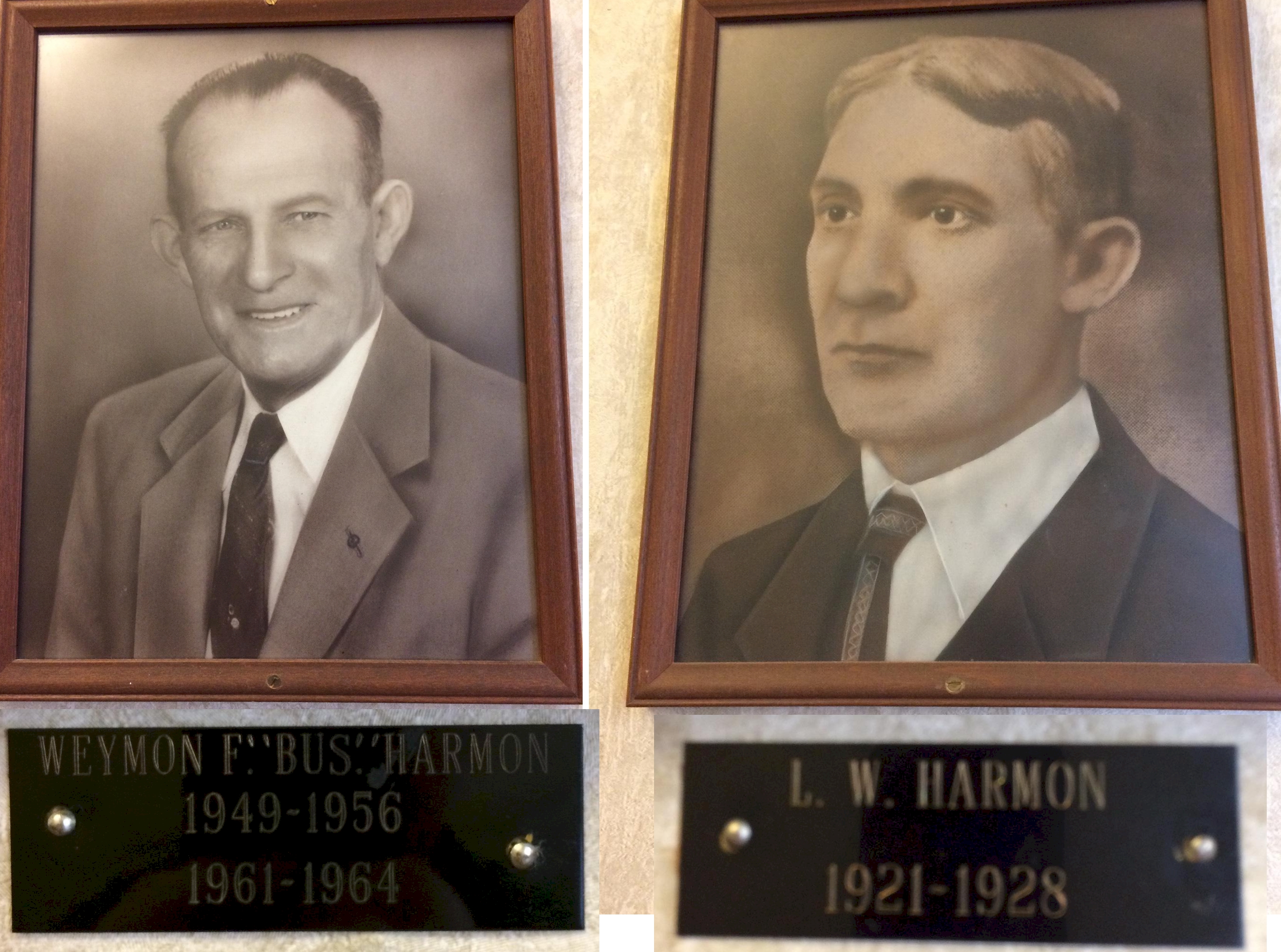
can be seen in the photo at the top right, the portraits of the
Harmons still hang in the main hallway of the courthouse, just
outside the door of the Clerk of Courts office in Walker County
Georgia. Sheriff "Bus"
Harmon was married to Mary, but they had no children, so Uncle
Bus's own personal sidearm was passed to my grandfather, James
Barry Burney, and then to his son, Barry Lee Burney. I,
James David Burney, acquired this snub-nosed S&W in 2017 from my
father. As
can be seen in the photo at the top right, the portraits of the
Harmons still hang in the main hallway of the courthouse, just
outside the door of the Clerk of Courts office in Walker County
Georgia. Sheriff "Bus"
Harmon was married to Mary, but they had no children, so Uncle
Bus's own personal sidearm was passed to my grandfather, James
Barry Burney, and then to his son, Barry Lee Burney. I,
James David Burney, acquired this snub-nosed S&W in 2017 from my
father.

I
have discussed the firearm with Doug Wicklund of the National
Firearms Museum at the headquarters of the National Rifle
Association and am presently attempting to obtain the
historical information for Walker
County Georgia that would "tell the story" of this Sheriff and
his personal sidearm.
Sheriff
"Bus" Harmon was
part of the investigation of
the Easter 1963 Lula Lake
Murders in Walker County
on Lookout Mountain
That Inspired a Novelist
The Frightening Real-Life Murders
That Inspired Cormac McCarthy’s
Spookiest Novel
"Child
of God"
In her book Reading
the World: Cormac McCarthy’s Tennessee Period, scholar Dianne
C. Luce points out that McCarthy seems to have been
influenced heavily by the 1963 so-called Lula Lake
Murders on Lookout Mountain, outside Chattanooga,
Tenn. The story goes that on Sunday, April 14, 1963,
after finishing an Easter lunch with his family,
27-year-old James Blevins donned a camouflage suit
and drove to Lookout Mountain to go “riding around”
and spy on couples parked on the back roads having
sex. He would later say that he had done this sort
of thing since he was 15, and was embarrassed by the
habit. According to the Rome
News-Tribune, once
on the mountain that afternoon, Blevins parked his
car and walked through the woods to Lula Lake, a
modest-sized pool, fed by a mountain stream. There,
Blevins came upon 16-year-old Carolyn Newell and her
fiancé, 19-year-old Pete Steele, a popular
Chattanooga Valley couple, sitting on the fender of
Steele’s car. Blevins approached the young couple
and talked with them, during which time, he later
said, he got the impression that another couple was
with them and somewhere nearby. Sometime after the
initial encounter, Blevins returned to the
car—presumably when Newell and Steele weren’t
around—and let the air out of a tire, because “he
thought if he stranded the car he could be able to
‘pick up’ the girls and ‘take them home,’” the News-Tribune reported.
No
one knows for sure what happened next, but Newell
and Steele didn’t make it home that evening.
The
discovery of Steele’s abandoned car at Lula Lake the
day after Easter set off a massive search for the
couple, which concluded six days later, with a
grisly discovery. “Steele’s
body was laced to a tree with binder’s twine and
evidence indicated that he had been strangled, using
the same twine and a short stick to tighten it
around his neck,” the News-Tribune reported
on May 8th, 1963. “Miss Newell’s body lay 100 to 150
feet away, her wrists held together by twine.
Testimony at a coroner’s inquest indicated that she
had been repeatedly raped, struck over the head, and
then choked to death. Witnesses said she probably
died several hours after Steele.” Newell’s clothing
had been “shredded,” and she was naked from the
waist down. Animals had eaten part of her leg.
In
the days before the couple was found, Blevins had
seemed unfazed, according to his ex-wife. But once
Blevins read stories of the missing couple in the
papers, he asked her to go with him to look for the
couple. But she was scared and refused. He remarked
that searchers were “wasting their time” dragging
Lula Lake for the bodies and added, “They’re on the
side of the mountain; they might still be alive.”
Other people had seen Blevins near Lula Lake that
day, and after the discovery of the bodies, Blevins
was picked up for questioning. He admitted to
authorities that he had talked with the couple that
day, but maintained that he knew nothing about the
murders. He told reporters that he had returned home
that evening and didn’t hear of the couple’s
disappearance until the following Friday. Law
enforcement was not convinced, and Blevins was held
without bond. Blevins’s lawyer later conceded that
his client was a “weakling,” a “sex degenerate”, and
a “peeping Tom,” but not a murderer. After
subjecting Blevins to a lie-detector test, a Georgia
Bureau of Investigation agent said that the suspect
had “guilty knowledge” of the couple’s murder, while
another agent who conducted a second test said
Blevins was “too emotionally disturbed” for accurate
results.
The
murders rocked Chattanooga, and the story went
national; even the New
York Times picked it up. Scholar Dianne C. Luce
notes that at the time, Cormac McCarthy was living
in Knoxville, just a couple hours up the highway
from Chattanooga, where the local papers also
covered the Lula Lake murders. Given how big the
story was in East Tennessee and its parallels with Child
of God, it seems likely that McCarthy was
familiar with the case and drew on it for
inspiration.
As
for Blevins, he was found guilty of murder in May,
1964. But the decision was later overturned, and he
eventually walked free. As a freeman, Blevins said
that he intended “to go out in the world and make a
good citizen.” He planned to rebuild his life, he
said, though “it’s hard to do after all I’ve lost
through this—work and healthy. But I believe I’m man
enough to do it."
|
|
As can be seen from the high
resolution photographs, this Smith & Wesson is a nickel-plated
revolver on a J-Frame and is known as a Chief's Special
pre-Model 36 five-shot revolver chambered in ".38 S&W SPL." and
it is in exquisite condition.
The serial number is clearly
visible on the edge of the chambers' wheel and on the butt, and
is a five-digit number without a prefixed letter in both of
those places (85XXX), but under the barrel the same serial
number is preceded by the letter "N", making it a probable 1956
time-frame of manufacture.
|
Jim Supica,
David Burney, & Steve Wilson |
In addition to busting up
mountain moonshine stills, Uncle "Bus" was Sheriff at the time
of the Lula Lake Murders that captured the entire nation's
attention at Easter 1963, and ultimately
inspired a novelist for a
super-scary novel set in the Appalachians. The author, Cormac
McCarthy, said it was an "unnamed" notorious person that
inspired his story, but as noted in the column at left, scholar
Dianne C. Luce believes the "unnamed" notorious person is in
fact James Blevins. His conviction was overturned in
Blevins v State on appeal to
the Georgia Court of Appeals.
Online blogs of people who
claim to be contemporaries of Mr. Blevins can be found where
claims of his boasts (without fear due to prohibitions against
"double jeapordy" when the second trial was dismissed on
technicalities) can be found. Sometimes this case is used as a
warning about the need for proper court procedures, else the
defendant can "get off" on a technicality.
|
Smith &
Wesson Chief's Special
pre-Model, 36 J-Frame, .38 S&W SPL.
In 1950, Smith &
Wesson introduced a totally new compact, five-shot,
.38 Special, snub-nose revolver at the International
Association of Chiefs of Police (IACP) convention held
in Colorado Springs, Colorado. The new J-Frame size
was intended to fill a position between the slightly
smaller I-Frame and the larger K-Frame, both dating
from the late 1890s. The J-Frame was a happy marriage
between the power of the K-Frame, in its typical .38
Special chambering, and the concealability of the
I-Frame in the .32s of the era, and in a very astute
marketing move the company allowed the convention
attendees to name the new gun. Not surprisingly, among
a delegation of police chiefs from all parts of the
country, the winning designation was “Chief’s
Special.”
The original Chief’s Special was a blued
double-action/single-action (DA/SA) revolver with a
thin 1.81-inch barrel, fixed sights, a casehardened
trigger and hammer, a round-butt grip frame, a coil
mainspring and checkered walnut grips. In 1957, when
S&W decided to start using model numbers, it became
the Model 36. An instant hit among chiefs and
plainclothes cops who liked the .38 Special but not
the weight or bulk of a Model 10 K-Frame with fixed
sights or Model 15 with adjustable sights, civilian
and LE buyers considered losing one round from a
larger six-shot revolver as more than a fair trade for
a very convenient package that carried well on the
belt, in a pocket or on an ankle, and the J-Frame was
quickly off and running.
Since 1950, the J-Frame has been—and still is—one of
Smith & Wesson’s greatest success stories, and one of
its best-selling frame sizes. That first Model 36 was
followed by another milestone for the company when the
Model 60 was introduced 15 years later in 1965 as the
industry’s first regular production stainless steel
revolver. The Model 60 mirrored the Model 36 in form,
with the same dimensions (with the exception of a
1.88-inch barrel) machined out of stainless instead of
carbon steel, and if you think the Model 36 was a
winner right out of the gate, the Model 60 immediately
created a backlog in orders not equaled until Dirty
Harry came along with his .44 Magnum Model 29 in 1971.
Waiting times ran up to six months at local gun shops,
and the corrosion-resistant snubbie quickly became one
of the most popular primary and backup carry guns in
America.
The J-Frame was a natural for further development.
Aluminum versions followed, sighted versions followed,
longer barrels followed, “hammerless” versions
followed, and the .357 Magnum caliber eventually
followed. The complete list of J-Frame models that
Smith &Wesson produced in the past 66 years is way too
long to cover here, but two of the most significant
early variations now considered classics in the
“Snubbie Hall of Fame” are the Model 40 Centennial
from 1952, with its totally enclosed internal hammer,
and the Model 49 Bodyguard from 1959 with its integral
hammer shroud. Both were blued steel models following
the basic size of the Model 36, but with two different
approaches to snag-free hammer designs for pocket
carry and, if needed, pocket firing. Stainless
variants of both were inevitable when S&W developed
the manufacturing process for the Model 60; the Model
40 begat the 640 in 1990, and the Model 49 generated
the 649 in 1985.
Today, with high-tech polymers being so popular,
sometimes a look backwards shows what old school was
like—and what old school can still do for us. |
|
More to come...

|