One's Recognition
of Truth & Error
Truth should be
recognized as truth regardless of where it is found. There
is both truth and error in Hubbard's Scientology, as there
is in every belief structure advanced by the adherents of
the belief structure.
A Necessary Dichotomy
It is
important to note a necessary dichotomy exists
between belief structures' "concepts" and the
various presentations by fallible humanity.
This is seen
in Christianity as well when one considers the
wide range of denominations of that faith system,
all of which attempt to convey the nature of God
and His intention, yet find disagreement with
other Christian denominations on specific matters
of interpretation of the Divine Perspective.
|
|
The Eternality of Things
There is an unclear matter regarding "eternality".
On pages 4-7 of the volume Science of
Survival, Hubbard seems to indicate that
the three items of physical universe, theta
universe, and divine entity are eternal, yet on
page 54 after identifying a Supreme Being to which
he assigns the name "God", he specifically states:
"One could consider
that God created the physical universe and the
theta universe."
This represents a lack of clarity to me as to
whether the three items are all eternal or two of
them are created by the third.
For someone as precise as Hubbard, this lack of
clarity is surprising since the words "could
consider" seem to indicate a somewhat
unresolved question in his mind. |
|
Hubbard's error is found in
the treatise regarding eternity, the origins of the
universe, the nature of Divinity, and what many refer to as
the human "soul" (which Hubbard has labeled theta, so
as to remove his explanation from the wide array of
definitions of "spirit" or "soul"). The truth of Hubbard's
Scientology is extensive as regards the natural laws that
govern the universe and human behavior.
Scientology's View of the Universe
The key components of the esoteric teachings of the origins
of the universe, the nature of Divinity, and the composition
of the living beings on the earth are thoroughly defined in
Science of Survival Chapter 1 (pages 1 - 15)
as follows:
- The following items are
"eternal"
- The physical universe
- The theta
universe
- A divine entity
or "infinite existence"
-
The
physical universe is composed of Matter, Energy, Space,
and Time, and is given the descriptive name MEST (the
first letter of each aspect of the physical universe)
-
The
theta universe is composed of ideas with its own
energy, space of operation, and its own time. "Further, it
computes, reasons, learns and retains what it learns."
-
A divine
entity exists and is recognized as the "Eighth Dynamic"
toward which one strives to survive. Interpretation of
this entity and its interaction and purpose is quite
specious. From my study of Scientology, it is a presence
seemingly disinterested in us as individuals, yet somehow
interacting with the physical and theta universes
by either its attempts to understand both or to confer
upon theta an understanding of MEST. In the
Ethics book, page 14, the definition of the Eighth
Dynamic is more specifically defined as "infinity" and
presupposes an intelligence in that realm. This lack of
clarity is intentional according to Fundamentals of
Thought (page 75) where Hubbard states: "It
is not established how mutation and evolution occur (if
they do), and the general authorship of the physical
universe is only speculated upon, since Scientology
does not invade the eighth dynamic."
Refer to comments below in my
Conclusion section.
-
"The
cycle of existence for theta consists of a disorganized
and painful smash into MEST and then a withdrawal, with a
knowledge of some of the laws of MEST, to come back and
smash into MEST again." This repetitive nature
is theta's intention to conquer the MEST universe.
"Life is a manifestation of theta-conquered
MEST." This faith system is similar to the
concept of reincarnation, but not of an entire individual
(as believed by many far-eastern religions), rather of the
theta, occurring in part, in whole, or in greater
measure than the previous iteration. Further, this is an "endless
process" of impingement (birth) and withdrawal (labeled
"death").
-
The
following assertions are foundational to the Scientology
faith:
- Theta plus MEST
equals life
- Theta and MEST
have a natural affinity for each other and combine,
linking the two universes
- Theta and MEST,
coming together too hard, get into a turmoil which we
call pain
- Turbulence of theta
and MEST, under the duress of too much impact, gives us
a Tone Scale
- Theta combined
with MEST becomes "life" and the living entity has a mind
of free theta and a mind of enturbulated theta.
The freely functioning mind is the logical mind and the
enturbulated mind is the reactive (unconscious) mind that
is not logical. As one's theta becomes more and
more enturbulated, the reactive mind becomes so prominent
that the logical mind is deteriorated to the point that
logical reasoning is diminished.
- As enturbulation occurs,
the reactive mind causes illogical behavior and
psycho-somatic illnesses, possibly so severe as to cause
death.
|
The Tone
Scale
|
40.0 |
Serenity of beingness |
|
30.0 |
Postulates |
|
22.0 |
Games |
|
20.0 |
Action |
|
8.0 |
Exhilaration |
|
6.0 |
Aesthetic |
|
4.0 |
Enthusiasm |
|
3.5 |
Cheerfulness |
|
3.3 |
Strong interest |
|
3.0 |
Conservatism |
|
2.9 |
Mild interest |
|
2.8 |
Contented |
|
2.6 |
Disinterested |
|
2.5 |
Boredom |
|
2.4 |
Monotony |
|
2.0 |
Antagonism |
|
1.9 |
Hostility |
|
1.8 |
Pain |
|
1.5 |
Anger |
|
1.4 |
Hate |
|
1.3 |
Resentment |
|
1.2 |
No sympathy |
|
1.15 |
Unexpressed resentment |
|
1.1 |
Covert hostility |
|
1.02 |
Anxiety |
|
1.0 |
Fear |
|
0.98 |
Despair |
|
0.96 |
Terror |
|
0.94 |
Numb |
|
0.9 |
Sympathy |
|
0.8 |
Propitiation |
|
0.5 |
Grief |
|
0.375 |
Making amends |
|
0.3 |
Undeserving |
|
0.2 |
Self-abasement |
|
0.1 |
Victim |
|
0.07 |
Hopeless |
|
0.05 |
Apathy |
|
0.03 |
Useless |
|
0.01 |
Dying |
|
0.0 |
Body death |
|
- 0.01 |
Failure |
|
- 0.1 |
Pity |
|
- 0.2 |
Shame |
|
- 0.7 |
Accountable |
|
- 1.0 |
Blame |
|
- 1.3 |
Regret |
|
- 1.5 |
Controlling bodies |
|
- 2.2 |
Protecting bodies |
|
- 3.0 |
Owning bodies |
|
- 3.5 |
Approval from bodies |
|
- 4.0 |
Needing bodies |
|
- 5.0 |
Worshipping bodies |
|
- 6.0 |
Sacrifice |
|
- 8.0 |
Hiding |
|
-10.0 |
Being objects |
|
-20.0 |
Being nothing |
|
-30.0 |
Can't hide |
|
-40.0 |
Total failure |
|
-
The
Tone Scale is
a measurement of free v. enturbulated theta and is
predictive of behavior as well as the well-being of an
individual, and is explanatory of past behaviors and
conditions of mental and physical health. The three
factors of theta determining one's position on the
Tone Scale is the amount of theta within an
individual, the quantity of that theta
enturbulated, and the ratio between the analytical mind
and the reactive mind. Enturbulated theta that is
not chronic (i.e. cannot be released from enturbulation)
can be set free by mechanisms of Scientology processing to
improve the mental and physical condition of the person.
A
Christian Answer to Scientology
While Scientologists assert that the faith of Scientology is
compatible with every other religion, the Christian must
disagree, for point 5 above is contrary to a key tenet of
Christian faith found in Hebrews 9:27 which clearly states
that we are all individuals and our consciousness exists
only once in the physical universe and will then return to
God for the moment of Divine Judgment. Thus the Christian
faith is incompatible with the religious belief system of
Scientology. See my Conclusion below for a more thorough
explanation.
Hold On
To What Is Good
However, this
incompatibility of Christianity and Scientology does not require the Christian to dismiss the
entirety of Hubbard's philosophy. In 1 Thessalonians 5:21,
Christians are instructed to "test everything and hold on to
what is good." There is actually much good in the writings
of L. Ron Hubbard. The man was brilliant in his detailed
analysis and comprehension of human behavior, one's physical
health, and the accuracy of his tabled
Tone Scale. In fact,
just as the
Periodic Table is
arranged such that the known elements and their
characteristics are commonly recognized, so also the
Tone Scale table
provides an ordering of characteristics according to
commonality as observed in human experience. The general
acceptance of the scientific periodic table is widespread
because it was created on the basis of observation,
testing, and proof. The accuracy of Hubbard's table is
stunning, for it is compiled on that same basis, yet not
only explains one's past mental and physical condition,
but provides the means of predicting one's future
condition.
Many other
essays and extensive writings are of high value as well,
for L. Ron Hubbard endeavored to thoroughly understand all
aspects of life -- both personal and business -- and he
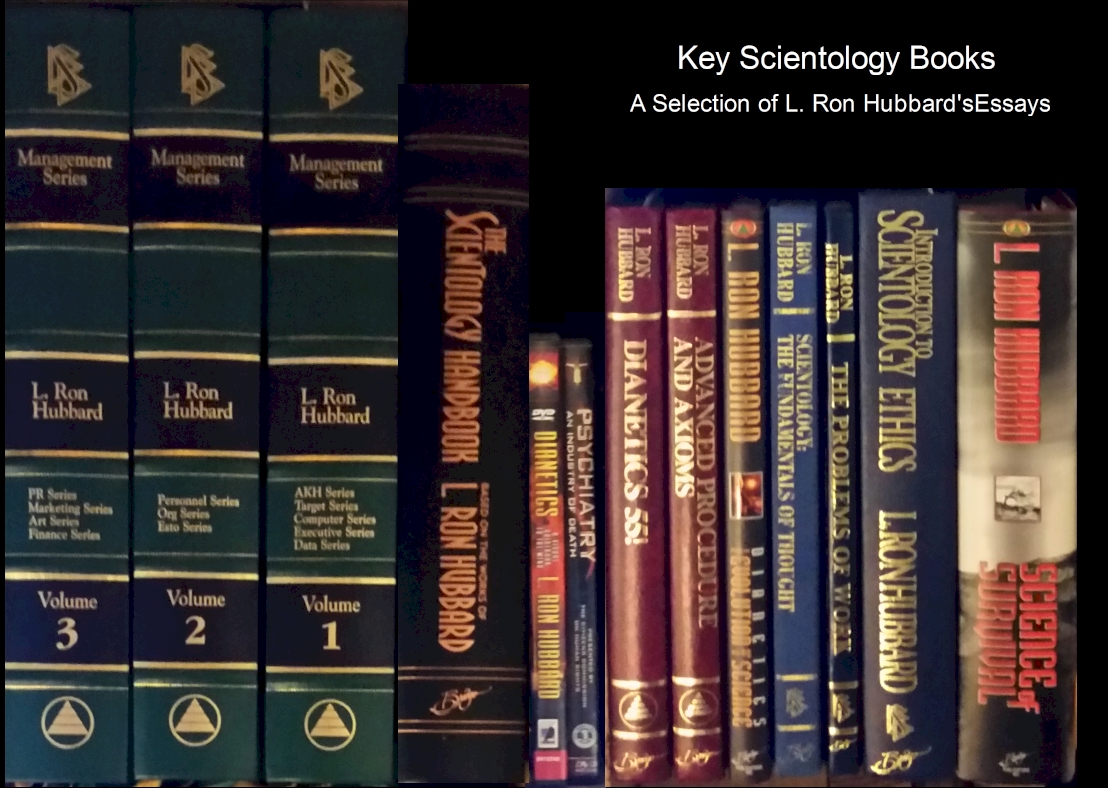
wrote extensively on these matters. His Management
Series is the basis for business conduct among
very many of the Fortune 500 companies. His medical
studies have advanced proven, natural healing methods that
stimulate the body's own self-repairing systems. And his
insight into psycho-somatic illness is pure brilliance
(given that over 80 percent of illness observed in human
beings is actually due to the reactive mind negatively
impacting the body), and his method of "auditing" to
correct the causes of psycho-somatic illness, as well as
what we often refer to as "mental illness", is pure
brilliance.
One of the most
useful volumes is a book he wrote entitled The
Problems of Work. This book has limitless
applications for it explains the concepts of order, chaos,
confusion, and clarity in both our business activities as
well as our personal lives and interactions with family,
friends, and others in our community. In this book, the
simplest "technologies" are identified, such as the
"stable datum" (pages 14-20), and other concepts, such as
"take a walk" and "look them over" (pages 80-82). We would
not think of walking as a technology, yet in addressing
exhaustion, it actually is a technology. The word
technology is defined as "the
application of scientific knowledge for practical purposes".
The scientific knowledge in this matter is clearly defined
on page 80 of the book The Problems of Work.
It is so brilliant that we miss it, and dismiss it. "Take
a walk" is not about exercise, rather it is about
"unfixing" the cause of exhaustion, and the body responds
to this "technology" by becoming refreshed.
What I have
found useful is everything L. Ron Hubbard has written
regarding the segment of the
Tone Scale between
the levels of zero and four. Everything below zero and
everything above four on Hubbard's
Tone Scale is
theoretical and it is the basis of approaching the
Scientology religious belief system, but between zero and
four, the
Tone Scale is
entirely observable in the physical universe and is
extremely accurate. This is why Scientology, as a
religion, focuses the vast majority of its efforts in this
portion of the range of Hubbard's
Tone Scale.
Another
incredibly useful item is the ARC Triangle. The ARC Triangle is the
keystone of living associations. This triangle is
the common denominator to all of life's activities and it correlates
to Hubbard's
Tone Scale. Below my
conclusion is a discussion of ARC and Hubbard's
Tone Scale. Its
brilliance will at once be obvious to a high toned
individual, but will be nonsense to a low toned person.
Conclusion
Scientology, as a religion, offers no salvation, no
heaven, no hell, no betterment of one's self except as
regards this iteration of the impingement of theta
(your "spirit") upon MEST (your body), thus the only real
benefit the religion of Scientology offers anyone is for
one's current existence in the physical universe as one
attempts to survive, or as one dwindles away toward death.
Yet in that offering, extremely valuable tools and
understanding has been documented by L. Ron Hubbard.
The lack of
clarity regarding the supposition of a Supreme Being is
intentional according to Fundamentals of Thought
(page 75) where Hubbard states: "It
is not established how mutation and evolution occur (if
they do), and the general authorship of the physical
universe is only speculated upon, since Scientology
does not invade the eighth dynamic."
Accordingly, the value of Scientology as a religion, is
specious, for it only offers understanding for the
experiences of life in this physical universe and
intentionally avoids offering insight into any greater
purpose or Divine presence.
For a
Christian, the Scientology faith regarding the nature of
the universe and its Supreme Being is incompatible with
Judeo-Christian doctrines, but for understanding human
behavior (without recognizing the influence of the
spiritual forces of the universe), Hubbard's
Tone Scale and the
associated ARC Triangle are invaluable. In fact, when one
well-versed in Biblical wisdom literature (e.g. Proverbs,
Ecclesiastes, etc.) endeavors to learn the Hubbard
Tone Scale and the
ARC Triangle, one readily recognizes the utility of
Scientology's primary focus between zero and four on
Hubbard's
Tone Scale. In
holding on to what is good, a Christian can learn much
from L. Ron Hubbard in understanding human behavior and
the health of one's mind and body.
Understanding ARC
(pronounced as individual letters "A-R-C", not pronounced as
the word "ark")
-
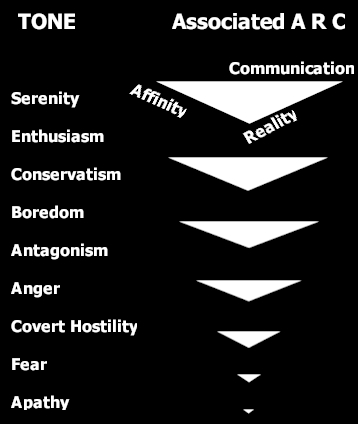 The first corner of the triangle is
called affinity. The most basic
definition is the consideration of distance, whether good or bad.
The word affinity is used with the triangle to mean love, liking, or
other emotional attitude with the context: "degree of liking". Under
affinity we have the various emotional tones of the
Tone Scale which is integral to a person's behavior and to their degrees
of "liking". The first corner of the triangle is
called affinity. The most basic
definition is the consideration of distance, whether good or bad.
The word affinity is used with the triangle to mean love, liking, or
other emotional attitude with the context: "degree of liking". Under
affinity we have the various emotional tones of the
Tone Scale which is integral to a person's behavior and to their degrees
of "liking".
- The second corner of the triangle
is reality. Reality could be defined as "that which appears to be".
Reality is fundamentally agreement. What we agree to be real is
real.
- The third corner of the triangle is
communication. Communication is the solvent for all things--improving
affinity and reality OR dissolving and destroying same.
The ARC Triangle is conceived to be
very spacious at the level of serenity and completely condensed at the
level below apathy (the level of inanimate matter--nothing, no
affinity, no shared reality, no communication).
Affinity, Reality, and Communication
are the basis of Hubbard's
Tone Scale.. The ARC Triangle is not equilateral,
rather affinity and reality are very much less important than
communication. Among the ARC Triangle laws, a communication to be
received must approximate the affinity level of the person to whom it
is directed. If there is a wide variation of affinity and reality, the
communication will be ineffective because A, R, and C rise and fall in
unison. It is impossible for a "conservative"
or "enthusiastic" personality to
effectively communicate with a "covert hostility" or a
"fear" personality, and
vice-versa. There must be a common affinity and reality for
communication to be effective.
A serene person has large capacity for
life and great affinity for all of life--recognizing things as they
truly are (reality) and communicating easily--both comprehending and
effectively (without misunderstandings) sharing thoughts with others
who are high in tone.
A
conservative person typically has some skepticism and may even
"reserve judgment" in dealing with some people, but generally is able
to share the "reality" expressed by others at or above his tone using
fairly effective communication.
At antagonism and below, a person, to
varying degrees, will not trust others and may even invalidate them or may
work against affinity by lying (the lowest form of communication,
promoting an irreconcilable difference in realities).
Descending "down tone" is the result
of a "dwindling spiral"--a phenomenon of the ARC Triangle whereby when
one breaks some affinity, agreement in reality goes down a little bit,
and then communication goes down (perhaps as an argument:ANGER--or even
lying:FEAR or COVERT HOSTILITY). This break in affinity makes it impossible to get affinity as
high as it was before... thus a little more loss of affinity with
further reduction in reality (radically different perceptions of the
same situations) and further reduction in communication
(yelling and
lying). This is the dwindling spiral in progress until it hits the
bottom which is no positive affinity (no love), no communication
(silence or via non-verbal), and no shared reality
(no relationship).
People who are low in tone
(including liars and manipulators of facts) become
incapable of communication, even though they may "talk". They do not
understand the reality that a higher tone person is attempting to
share (perhaps so fearful as to be incapable of
comprehending reality or so insidious as to be trying to manipulate
circumstances). They also are ineffective in communicating their own thoughts
such that their statements may invalidate the other person or may
suddenly "change the subject"
("Oh yeah, well what about...").
These individuals may seem
erratic, and their "talk" be peppered with bizarre references or lies trying desperately to avoid
the obviousness of their wrongness. The
worst examples of this can be seen in neurotic or even psychotic
persons intermingling wildly irrelevant chatter in any attempted
discourse (such people may be labeled
schizophrenic, or worse).
Another key characteristic of
such a low-toned person is that they expect they always should be
forgiven without any requirement that they correct or amend their
wrongs and their promises are not typically trustworthy. Additionally, the high-toned person has an expansive
and far more accurate view of reality while the low-toned person has a
distorted, very limited view of reality, drawing conclusions that they
would not deduce if their understanding of reality was not aberrated. Since A, R, and C rise and
fall together, the ability to communicate and share a common affinity
is impossible between such persons and a correlated gulf exists
between them in perceptions of reality.
A key factor is the lower
toned person's desperate attempt to be "right" (see
other essay at right) in the face of
what they perceive to be an "attack". In this case, the higher tone
person must diffuse the situation, perhaps even by complete
withdrawal, so that the lower tone person can be "right" without
further degradation. With the end of communication and irreconcilable
realities, there may be the loss of any positive relationship.
Repairing such damage can only occur with a rise in tone, though a
future repair may never restore the original level of ARC nor the
original relationship.
As people or whole nations descend
down the tone scale, effective communication becomes more and more
difficult and things with which they can find agreement become more
and more solid (perceptions and concepts are
nearly impossible to agree, only borders and clinched fists). Thus we have friendly discourse high on the tone
scale, with arguments/penalties as we go "down tone", descending to
fights/skirmishes, ultimately arriving at war at the bottom of the
tone scale.
On the personal level, the dwindling
spiral leads to differences in objectives, arguments, invalidation,
lies, and loss of affinity and reality such that no relationship can
exist.
On the national level, when the
affinity level equals hate, the agreement of reality is limited to
solid matter and the communication is bullets and bombs.
You see, lively and endearing
communication exists at the highest level of the tone scale where
affinity is a grand degree of "like" and reality is nearly perfectly
shared with other people's perceptions of the universe in which we live.
And at the other end of the tone scale, communication occurs even in
the absence of spoken words. Non-verbal communication is also
communication, and on the personal level can be a divorce proceeding
handled by lawyers or on a national level can be weapons handled by
soldiers.
What is needed for improving ARC? A
rising tone level. One must rise above FEAR
in the direction of
SERENITY seeking the most spacious and beneficial ARC Triangle. This may take
a long time and is impossible without assistance, but the benefits can begin immediately because along the
way, one will find improving happiness in life, better understanding
of reality, and more accurate reception of other people's efforts
toward communication as well as one's own continually improving
methods of communicating.
|
|
Scientology's Rejection of Evolution
On page 2 of
Science of Survival, Hubbard clearly rejects
the notion of atheistic evolution, ridiculing it as
"the 'mud-to-Man' theory,
and it is just a crude theory...". In
doing so, he aptly and succinctly demonstrates the
massive foolishness of the theory of evolution. He
specifically states:
"A
gross error has been made by scientists in the
past who sought, materialistically, to explain
life on the basis of mud, chemicals and
electricity. It was the contention of these
individuals that matter and electrical energy,
operating in space and time, combined in some
incredibly lucky moment to form a
self-perpetuating unit and that this item
fortuitously grew and grew and one day Man appeard
on the scene. This childlike logic breaks down if
only on the basis of the odds against it. It
breaks down again when evolution, as postulated,
is seen to be of only limited usefulness, being
actually as full of holes as an
ocarina."
Curiously, Hubbard
does indicate (on page 535) that perhaps the Supreme
Being is influencing a type of evolution as theta
impinges MEST. See my comments in the conclusion
section on the left of this page. |
You Can Be
Right
L.
Ron Hubbard, July 1961
Rightness and wrongness form
a common source of argument and struggle. The concept of
rightness reaches very high and very low on the
Tone Scale.
And the effort to be right is the last conscious striving of
an individual on the way out. I-am-right-and-they-are-wrong
is the lowest concept that can be formulated by an unaware
case [case=person in need of help in
their circumstances].
What is right and what is wrong are not necessarily
definable for everyone. These vary according to existing
moral codes and disciplines and, before Scientology, despite
their use in law as a test of "sanity", had no basis in fact
but only in opinion.
In Dianetics and Scientology a more precise definition
arose. And the definition became as well the true definition
of an overt act. An overt act is not just injuring someone
or something: an overt act is an act of omission or
commission which does the least good for the least number of
dynamics or the most harm to the greatest number of
dynamics.
Thus a wrong action is wrong to the degree that it harms the
greatest number of dynamics. And a right action is right to
the degree that it benefits the greatest number of dynamics.
Many people think that an action is an overt simply because
it is destructive. To them all destructive actions or
omissions are overt acts. This is not true. For an act of
commission or omission to be an overt act it must harm the
greater number of dynamics. A failure to destroy can be,
therefore, an overt act. Assistance to something that would
harm a greater number of dynamics can also be an overt act.
An overt act is something that harms broadly. A beneficial
act is something that helps broadly. It can be a beneficial
act to harm something that would be harmful to the greater
number of dynamics.
Harming everything and helping everything alike can be overt
acts. Helping certain things and harming certain things
alike can be beneficial acts.
The idea of not harming anything and helping everything are
alike rather mad. It is doubtful if you would think helping
enslavers was a beneficial action and equally doubtful if
you would consider the destruction of a disease an overt
act.
In the matter of being right or being wrong, a lot of muddy
thinking can develop. There are no absolute rights or
absolute wrongs. And being right does not consist of being
unwilling to harm and being wrong does not consist only of
not harming.
There is an irrationality about "being right" which not only
throws out the validity of the legal test of sanity but also
explains why some people do very wrong things and insist
they are doing right.
The answer lies in an impulse, inborn in everyone, to try to
be right. This is an insistence which rapidly becomes
divorced from right action. And it is accompanied by an
effort to make others wrong, as we see in hypercritical
cases. A being who is apparently unconscious is still being
right and making others wrong. It is the last criticism.
We have seen a "defensive person" explaining away the most
flagrant wrongnesses. This is "justification" as well. Most
explanations of conduct, no matter how far-fetched, seem
perfectly right to the person making them since he or she is
only asserting self-rightness and other-wrongness.
We have long said that that which is not admired tends to
persist. If no one admires a person for being right, then
that person's "brand of being right" will persist, no matter
how mad it sounds. Scientists who are aberrated cannot seem
to get many theories. They do not because they are more
interested in insisting on their own odd rightnesses than
they are in finding truth. Thus we get strange "scientific
truths" from men who should know better, including the late
Einstein. Truth is built by those who have the breadth and
balance to see also where they're wrong.
You have heard some very absurd arguments out among the
crowd. Realize that the speaker was more interested in
asserting his or her own rightness than in being right.
A thetan [an individual, not the mind
or body, but rather the real person] tries to be
right and fights being wrong. This is without regard to
being right about something or to do actual right. It is an
insistence which has no concern with a rightness of conduct.
One tries to be right always, right down to the last spark.
How then, is one ever wrong?
It is this way:
One does a wrong action, accidentally or through oversight.
The wrongness of the action or inaction is then in conflict
with one's necessity to be right. So one then may continue
and repeat the wrong action to prove it is right.
This is a fundamental of aberration. All wrong actions are
the result of an error followed by an insistence on having
been right. Instead of righting the error (which would
involve being wrong) one insists the error was a right
action and so repeats it. As a being goes down scale it is harder and harder to
admit having been wrong. Nay, such an admission could well
be disastrous to any remaining ability or sanity. For rightness is the stuff of which survival is made. And as
one approaches the last ebb of survival one can only insist
on having been right, for to believe for a moment one has
been wrong is to court oblivion. The last defense of any being is "I was right". That applies
to anyone. When that defense crumbles, the lights go out.
So we are faced with the unlovely picture of asserted
rightness in the face of flagrant wrongness. And any success
in making the being realize their wrongness results in an
immediate degradation, unconsciousness, or at best a loss of
personality. Pavlov, Freud, psychiatry alike never grasped
the delicacy of these facts and so evaluated and punished
the criminal and insane into further criminality and
insanity.
All justice today contains in it this hidden error - that
the last defense is a belief in personal rightness
regardless of charges and evidence alike, and that the
effort to make another wrong results only in degradation.
But all this would be a hopeless impasse leading to highly
chaotic social conditions were it not for one saving fact:
All repeated and "incurable" wrongnesses stem from the
exercise of a last defense: "trying to be right". Therefore
the compulsive wrongness can be cured no matter how mad it
may seem or how thoroughly its rightness is insisted upon.
Getting the offender to admit his or her wrongness is to
court further degradation and even unconsciousness or the
destruction of a being. Therefore the purpose of punishment
is defeated and punishment has minimal workability.
But by getting the offender off the compulsive repetition of
the wrongness, one then cures it.
But how?
By rehabilitating the ability to be right! This has limitless application - in training, in social
skills, in marriage, in law, in life.
Example: A wife is always burning dinner
[also consider the woman who always
says she is a bad cook, then proves it]. Despite scolding,
threats of divorce, anything, the compulsion continues. One
can wipe this wrongness out by getting her to explain what
is right about her cooking. This may well evoke a raging
tirade in some extreme cases, but if one flattens the
question, that all dies away and she happily ceases to burn
dinners. Carried to classic proportions but not entirely
necessary to end the compulsion, a moment in the past will
be recovered when she accidentally burned a dinner and could
not face up to having done a wrong action. To be right she
thereafter had to burn dinners. [self
fulfilling 'prophecy'?] Go into a prison and find one sane prisoner who says he did
wrong. You won't find one. Only the broken wrecks will say
so out of terror of being hurt. But even they don't believe
they did wrong.
A judge on a bench, sentencing criminals, would be given
pause to realize that not one malefactor sentenced really
thought he had done wrong and will never believe it in fact,
though he may seek to avert wrath by saying so.
The do-gooder crashes into this continually and is given his
loses by it.
But marriage, law and crime do not constitute all the
spheres of living where this applies. These facts embrace
all of life. The student who can't learn, the worker who
can't work, the boss who can't boss are all caught on one
side of the right-wrong question. They are being completely
one-sided. They are being "last-ditch-right". And opposing
them, those who would teach them are fixed on the other side
"admit-you-are-wrong". And out of this we get not only
no-change but actual degradation where it "wins". But there
are no wins in this imbalance, only loses for both.
Thetans on the way down [the emotional
tone scale] don't believe they are wrong because they
don't dare believe it. And so they do not change.
Many a preclear [a person enturbulated]
in processing [a Scientology
procedure] is only trying to prove himself right and
the auditor [the person performing the
processing procedure] wrong, particularly the lower
case levels, and so we sometimes get no-change sessions
[no improvement for the preclear].
And those who won't be audited at all
[refuse any help with their problems] are totally fixed on
asserted rightness and are so close to gone that any
question of their past rightness would, they feel, destroy
them.
I get my share of this when a being, close to extinction,
and holding contrary views, grasps for a moment the
rightness of Scientology and then in sudden defense asserts
his own "rightnesses", sometimes close to terror.
It would be a grave error to go on letting an abuser of
Scientology abuse. The route is to get him or her to explain
how right he or she is without explaining how wrong
Scientology is, for to do the last is to let them commit a
serious overt. "What is right about your mind" would produce
more case change and win more friends than any amount of
evaluation or punishment to make them wrong.
You can be right. How? By getting another to explain how he
or she is right - until he or she, being less defensive now,
can take a less compulsive point of view.
You don't have to
agree with what they think. You only have to acknowledge
what they say. And suddenly they can be right.
A lot of things can be done by understanding and using this
mechanism. It will take, however, some study of this article
before it can be gracefully applied - for all of us are
reactive to some degree on this subject. And those who
sought to enslave us did not neglect to install a
right-wrong pair of items on the far back track. But these
won't really get in your way.
As Scientologists, we are faced by a frightened society who
think they would be wrong if we were found to be right. We
need a weapon to correct this. We have one here.
And you can be right, you know. I was probably the first to
believe you were, mechanism or no mechanism. The road to
rightness is the road to survival. And every person is
somewhere on that scale.
You can make yourself right,
amongst other ways, by making others right enough to afford
to change their minds. Then a lot more of us will arrive.
The Dynamics
The Eight Dynamics are:
- Self
- Family
- Groups (work,
nation, etc.)
- Mankind (all of humanity)
- All Living Things
- Physical Universe
- Spiritual Universe
- Supreme Being
(actually "Infinity", but undefined)
What do
these things mean? This is worth one's time to study and
learn, for in understanding the dynamics (and the
"conditions" which are addressed by Scientology processing),
one can truly make right decisions about their life and
actions in life.
 |
|


 I have studied
Scientology for twelve years, having read extensively of the
writings of L. Ron Hubbard, and having completed some of the
working tools accompanying many of those writings. I have been
quite impressed with Hubbard's understanding of human behavior,
finding his views of this matter incredibly accurate. I have
also been impressed with his extensive study of medical
procedures and the many religions practiced around the world.
This curriculum will examine the religion of Scientology and
provide a Christian perspective of its major tenets.
I have studied
Scientology for twelve years, having read extensively of the
writings of L. Ron Hubbard, and having completed some of the
working tools accompanying many of those writings. I have been
quite impressed with Hubbard's understanding of human behavior,
finding his views of this matter incredibly accurate. I have
also been impressed with his extensive study of medical
procedures and the many religions practiced around the world.
This curriculum will examine the religion of Scientology and
provide a Christian perspective of its major tenets.